Flymen Fishing Company
Fish-Skull Weasel Bass Fly | South African Muishond Pattern | Deer Hair & Rabbit Fur Zonker | Dumbbell Eye | Weed Guard | Chartreuse Hot Spot | 3" | #4 Hook | Largemouth Bass | Flymen
Fish-Skull Weasel Bass Fly | South African Muishond Pattern | Deer Hair & Rabbit Fur Zonker | Dumbbell Eye | Weed Guard | Chartreuse Hot Spot | 3" | #4 Hook | Largemouth Bass | Flymen
SKU:FS-WBF-B4
Couldn't load pickup availability
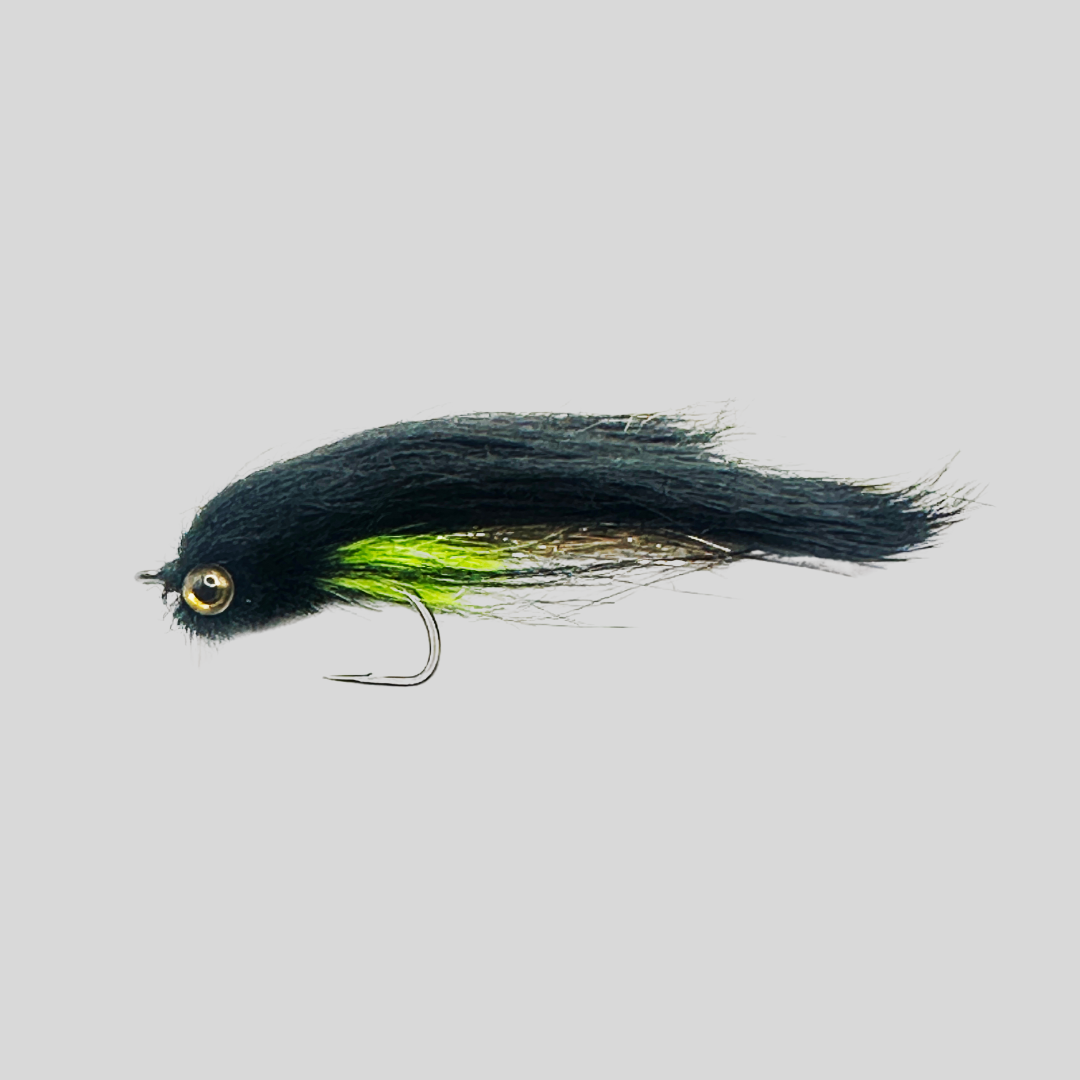
South African Muishond Bass Pattern. 3.0" (75mm). #4 Hook. Deer Hair Body + Rabbit Fur Zonker. Weighted Dumbbell Eye. Stiff Weed Guard. Chartreuse Belly Hot Spot. Slow Cover Fishing for Largemouth Bass.
The Fish-Skull Weasel Bass Fly by Flymen Fishing Company is a direct adaptation of South Africa’s legendary Muishond — a deer hair and rabbit fur zonker bass fly that has been a proven large bass pattern in South African stillwater fisheries for decades — redesigned and refined by Flymen for largemouth bass applications in the United States. At 3.0" (75mm) on a #4 hook, the Weasel is sized to imitate a minnow or small baitfish moving slowly near cover where large bass hold in ambush. Deer hair provides a naturally buoyant body profile; a weighted dumbbell eye at the head counters the deer hair’s buoyancy to produce a slow, sink-and-hover action; a rabbit fur zonker strip on the tail produces a continuous, breathing pulse in the water; a stiff weed guard protects the hook point through repeated contact with reeds, grass, dock posts, and submerged timber; and a bright chartreuse belly hot spot provides a concentrated visual trigger at close range. A must-have pattern for any fly angler targeting largemouth bass in heavy cover.
The Muishond — South Africa’s Legendary Bass Pattern
The Muishond (Afrikaans for “weasel”) is one of the most celebrated and widely used largemouth bass fly patterns in South Africa, where bass fly fishing has developed a distinct tradition and technical sophistication largely independent of North American streamer design. South African bass waters are often rich in aquatic vegetation, submerged timber, and reed banks — dense cover environments where large bass hold tight and ambush prey at extremely close range. The Muishond was developed specifically to be fished through and around this dense cover: the weed guard keeps the hook clean through the cast into reeds and structure; the dumbbell eye sinks the fly slowly through the cover rather than allowing it to float over it; and the rabbit fur zonker pulses with the water displacement created by the bass itself as it approaches for the strike, triggering a final commit before the fish has even opened its mouth. Flymen’s adaptation of this South African pattern brings a proven large-bass trigger to North American waters where the same cover conditions — hydrilla mats, lily pad edges, dock structure, and fallen timber — hold exactly the type of fish the Muishond was designed to catch.
Construction — Why Each Element Matters
- Deer Hair Body — naturally buoyant; deer hair is hollow, which means it resists sinking and creates an upward lift tendency in the fly; combined with the dumbbell eye weight, this buoyancy creates a balanced, slow-sinking action rather than a fast drop — the fly eases down through the water column and through cover rather than plummeting past the strike zone; the deer hair also has a soft, lifelike texture that bass hold briefly rather than rejecting immediately on contact
- Weighted Dumbbell Eye — positioned at the head to counter the deer hair’s buoyancy; the dumbbell creates a head-heavy balance that produces the characteristic Weasel action: the fly sinks head-first, with the rabbit fur tail rising behind it, producing a nose-down posture that mimics a minnow that has lost orientation and is descending head-first through the water column; on the strip, the dumbbell drives the head downward while the tail whips upward — a baitfish distress action that triggers predatory bass
- Rabbit Fur Zonker Strip — the tail material; rabbit fur fibers are extremely fine and soft, absorbing water quickly and producing a flowing, breathing action in the slightest water movement; the zonker strip pulses continuously during the retrieve and during the pause, maintaining the illusion of a living baitfish even when the angler is not moving the fly; bass approaching the Weasel from behind will see the rabbit fur tail moving before the fly itself is stripped, which triggers the final predatory commit
- Stiff Weed Guard — a monofilament or stiff fiber weed guard that bridges the hook gap, protecting the point from fouling on reeds, grass, hydrilla, dock structure, and woody debris during the cast and retrieve; the weed guard is stiff enough to deflect structure contact but soft enough to compress on the hookset, allowing the hook point to drive through cleanly; without the weed guard, casting the Weasel into the heavy cover where it is most effective would result in constant fouling
- Chartreuse Belly Hot Spot — a concentrated area of chartreuse material tied at the belly of the fly that creates a color contrast focal point; when a bass approaches the Weasel from below (the typical predator approach angle for a sinking fly), the chartreuse belly is the most visible element of the fly at close range; the hot spot serves as a visual trigger that focuses the bass’s strike on the head and hook area of the fly rather than the tail, which improves hookup rates on fish that commit to the fly
How to Fish It
- Cast to Cover — Dock Posts, Lily Pad Edges & Fallen Timber — the Weasel is designed to be cast directly into and adjacent to dense cover where standard flies cannot be fished without constant fouling; pitch the fly to within inches of a dock post, the edge of a lily pad mat, the shadow of a fallen tree, or the inside pocket of a reed bank; the weed guard handles contact with these elements throughout the cast and retrieve; allow the fly to sink on a semi-slack line after landing — the rabbit fur tail pulses during the fall and the dumbbell eye produces the nose-down sinking posture that is the Weasel’s primary trigger
- Slow Strip & Long Pause — Cover Fishing — after the fly has sunk to the target depth, retrieve with a slow, deliberate single strip of 6–12 inches followed by a 3–5 second pause; during the pause, the dumbbell eye holds the head down while the rabbit fur tail continues to undulate in the residual water movement; most strikes occur during the pause, particularly from large fish that are holding tight to structure and watching the fly settle after the strip; resist the urge to strip quickly — the Weasel is a slow-presentation fly and its action is most effective at low retrieve speeds where the material movement is most visible
- Vertical Drop — Dock Pilings & Bridge Structure — drop the Weasel vertically alongside a piling or bridge support and allow it to sink on a semi-slack line, watching for a line twitch or sudden weight on the descent that signals a bass has taken the fly on the fall; bass holding at specific depth levels on vertical structure will intercept the fly as it passes their holding position; after it reaches the bottom, slowly lift and lower the fly to animate it at the fish’s depth before moving to the next piling
- Reed Bank Edges — Strip Along the Edge — cast parallel to a reed bank or grass edge and retrieve the Weasel slowly along the face of the structure, keeping the fly within 6–12 inches of the reed stems; bass holding inside the reed bank will track movement along the edge and commit when the fly pauses; the weed guard allows the fly to make contact with the reed stems throughout the retrieve without fouling
Target Species
Largemouth Bass • Smallmouth Bass • Spotted Bass • Pike • Pickerel • Any ambush predator targeting minnows in heavy freshwater cover.
Specs
- Pattern: Weasel Bass Fly (adapted from South African Muishond)
- Length: 3.0" (75mm)
- Hook: #4
- Body: Deer hair
- Tail: Rabbit fur zonker strip
- Weight: Dumbbell eye
- Hook Protection: Stiff weed guard
- Hot Spot: Chartreuse belly
- SKU: FS-WBF-B4
- Brand: Fish-Skull by Flymen Fishing Company
In stock and ready to ship.
Share